Table Of Content
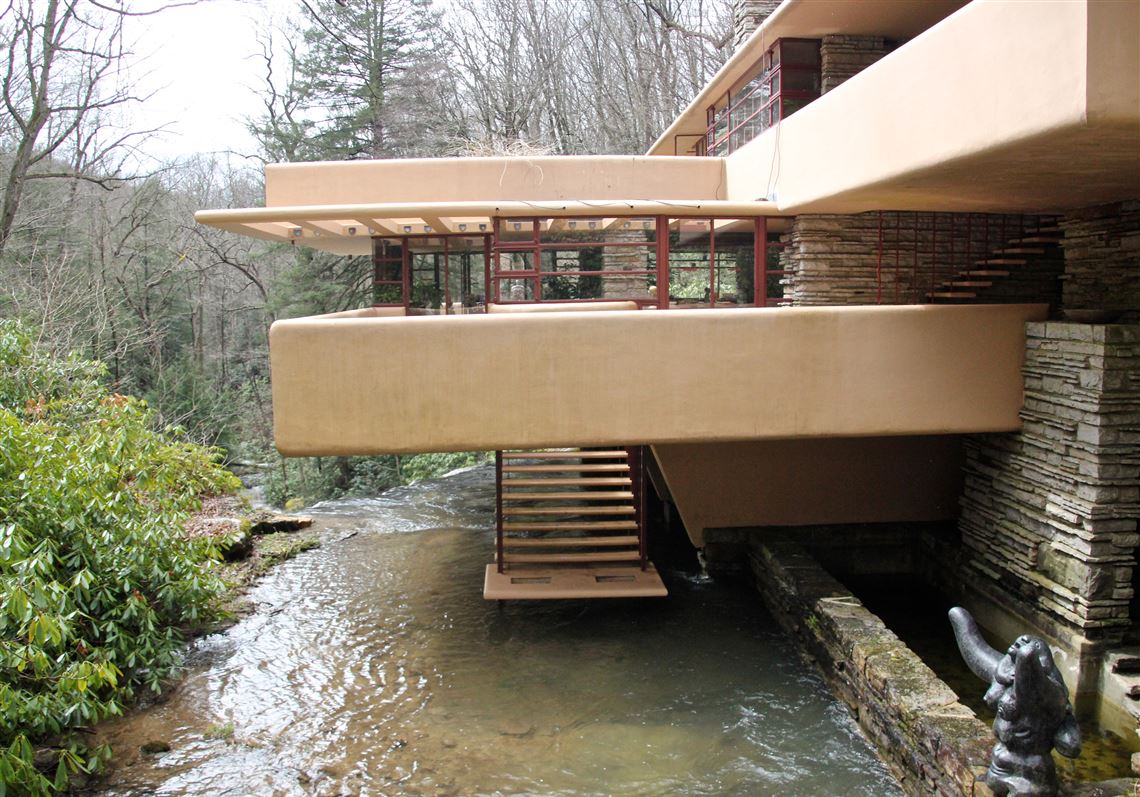
While Frank Lloyd Wright’s architectural masterpiece is open to the public almost all year round, with the exception of January and February where weather conditions can make traveling in the area a bit perilous. A visit to Fallingwater is amazing any time of year, but it is particularly stunning in the autumn months when the leaves on the trees begin the colorful change. On the North face of the house, the opposite of that which “flies” over the river, there are two pergolas, like awnings, which run from the exterior wall to a stone incline and hang over the path which leads to the entrance. This means was utilised by Wright to make clear the respect for nature with which he designed the house. The shadows cast by the pergolas resemble those of the tree trunks; an effect which makes the shadow of the house fade into those of the trees.
Celebrating World Art Day April 15, 2024
The architect designed almost 170 custom wood furnishings for the house in a style that blended harmoniously with the architecture. For the vertical elements of the home—its structural piers and chimney, which also run through the interiors—Wright took inspiration from the specificity of Fallingwater’s isolated Pennsylvania site, as chosen by the nature-loving Kaufmann family. He clad them in local sandstone laid in horizontal striations, like the forms in its natural surroundings. To further the house’s connection to nature, Wright used flagstone flooring inside and out and employed large sheaths of glass windows for visual continuity. The clients, Pittsburgh department store magnate Edgar J. Kaufmann and his family, agreed.
Timeline
“I want you to live with the waterfall, not just to look at it”, were his exact words to the Kaufmanns. The Fallingwater house served as the Kaufmann family’s weekend retreat for 26 years. His mother, sadly, took her own life in the Fallingwater house and his dad died shortly after. Edgar Jr. continued to live there with his partner who was the architect and designer Paul Mayen, who designed the gift store, café, and tourist facility that opened its doors in 1981.

Planning Your Visit
The Prairie School developed an architectural style with characteristics such as strong horizontal lines, flat, overhanging roofs, horizontal banded windows, and the integration of buildings with their landscapes. Fallingwater's façade also showcases Wright's meaningful approach to materials. The external walls are composed of locally quarried Pottsville sandstone and reinforced concrete. This concrete concoction, in turn, is made up of cement, sand, and rounded river gravel. The home's “trays,” or terraces, are coated in stucco, which Wright painted a neutral and nature-inspired ochre color. Deeply rooted in his love of nature, organic architecture's primary intention is to unify buildings with their environments and visually blur the line between built structures and natural habitats.
11 Frank Lloyd Wright Houses You Can Visit Across the U.S. - AFAR Media
11 Frank Lloyd Wright Houses You Can Visit Across the U.S..
Posted: Fri, 18 Aug 2023 07:00:00 GMT [source]
Despite his difficult childhood, Wright had big ambitions and was set on becoming an architect, as his mother predicted. He went to study at the University of Wisconsin-Madison but ended up leaving the school before achieving his degree. Thirty years later, Wright merged with the Joseph Lyman Silsbee architectural firm in Chicago as a construction supervisor and accredited draftsman where he worked on the Unity Chapel for his family. She also provided him with Froebel Gifts, which were very popular educational blocks part of an innovative kindergarten curriculum at the time. In his autobiography, Wright claims that these blocks were an integral part of his fascination with designing and building. This philosophy guided the ins-and-outs of Wright's entire creative process.
Design
Fallingwater inspired gingerbread house takes first place Local News latrobebulletinnews.com - latrobebulletinnews.com
Fallingwater inspired gingerbread house takes first place Local News latrobebulletinnews.com.
Posted: Sun, 10 Mar 2024 08:00:00 GMT [source]
On entering, we are faced by the “music corner”, whose etymology is unknown, to the right is the sofa area and behind the “music corner” is the “staircase of water”, so called because it leads down to a small platform beside the river. The steps of the “staircase of water” are suspended from traction cables, attached to the first slab. The building grows from inside out and extends according to the needs of its inhabitants. In this way, it can be modified, as in organic architecture the construction is conceived as a living thing and can alter its form. The Conservancy owns and operates the Fallingwater house, which is open to the public to view as a museum.

Fallingwater: Everything to Know About Frank Lloyd Wright’s Masterpiece
Perfect cool temperate mornings move into hot days, but relief comes in the evening as a breeze picks up and the sun sets. While planning your itinerary for the day we have some lovely suggestions for stops along the way. On your drive out, you’ll pass by Amish furniture shops which are always worth a look. For lunch or an early evening dinner, The Bittersweet Cafe, is a charming spot for farm-to-table casual dining.
Art Periods – A Detailed Look at the Art History Timeline
They often went for picnics at Bear Run and always dreamed out loud about having a holiday home there. The Kaufmann’s were also well known for their very popular Kaufmann’s department store. The house was built as a weekend home for owners Mr. Edgar Kaufmann, his wife, and their son, whom he developed a friendship with through their son who was studying at Wright's school, the Taliesin Fellowship.
Interior design
Critics raved after Fallingwater opened three years later, with Time magazine calling it Wright’s “most beautiful job” in a January 1938 cover story on the architect. Wright was one of the founding minds of “organic architecture” which combines art and nature into one cohesive design. The use of stone, wood, and unique geometry creates one of the most brilliant works that you’ll ever get to see. The mansion now operates as a public museum allowing visitors from around the world to tour Wrights iconic design in-person. Fallingwater, weekend residence near Mill Run, southwestern Pennsylvania, that was designed by American architect Frank Lloyd Wright for the Kaufmann family in 1935 and completed in 1937. The house’s daring construction over a waterfall was instrumental in reviving Wright’s architecture career and became one of the most famous 20th-century buildings.
Some walls and other vertical elements which define the spaces of the house, as well as the floors, were covered in the local stone. The walls of the living room, like those of the rest of the house, are the same as the exterior ones, with parts of masonry made from the extracted stone. The floor is brown stone and the ceiling has a pattern which goes round the integrated light fittings, designed specifically for this house. On entering the dining room, on the right hand side, is the chimney, surrounded by natural stones which emerge from the floor.
The facade windows were also designed specially to open up at the corners, opening up the house to the exterior even further. Because of the cantilevering system that takes up the entirety of what should have been a ground floor, if built on solid ground, the living quarters of the building start on the first floor. The house took on "a definite masonry form" that related to the site, and for the terraces they decided on a reinforced-concrete structure. The circulation through the house consists of dark, narrow passageways, intended this way so that people experience a feeling of compression when compared to that of expansion the closer they get to the outdoors. In addition, Fallingwater's structural system includes a series of very bold reinforced concrete cantilevered balconies. Pronounced deflection of the concrete cantilevers was noticed as soon as the formwork was removed during construction.
As previously mentioned, the effects of nature combined with Wright’s stubborn ways are continually causing the building to reach the end of its life if not for the ongoing preservation attempts. The first phase of the below restorations is set to begin work in 2022, depending on whether the desired donation goals are met. In 1997, emergency beams were installed, and the structure was properly restored in 2002. There was said to be a dispute between Kauffman and wright, as Kauffman wanted to add more reinforcement to the concrete, but Wright refused, he even went as far as threatening to resign from the project.


No comments:
Post a Comment