Table Of Content
In December 1935, an old rock quarry was reopened to the west of the site to provide the stones needed for the house's walls. Wright visited only periodically during construction, assigning his apprentice Robert Mosher as his permanent on-site representative.[18] The final drawings were issued by Wright in March 1936 with work beginning on the bridge and main house in April. Enjoy a day visiting 2 homes designed by Frank Lloyd Wright in the scenic Laurel Highlands. Allow a full hour to get to Fallingwater and be sure to call for a reservation in advance. While in the area, stop at some of the gift shops in Chalk Hill, lunch at the Stone House and enjoy a glass of wine at the Christian W. Klay Winery.
Grounds and exterior access, house interior not included
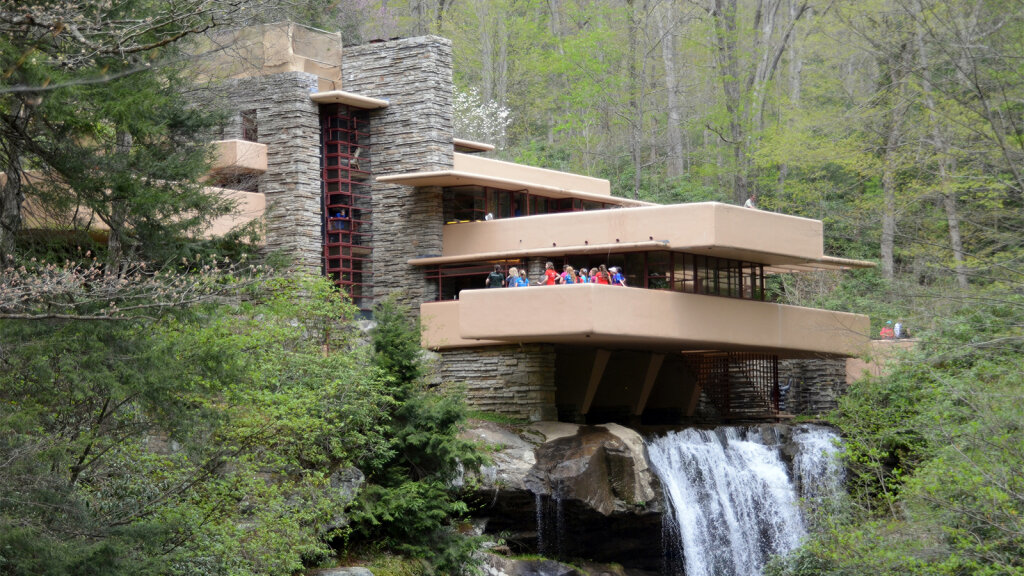
Built in 1935, Fallingwater is still thought of as an architectural marvel, considering it is constructed over a waterfall set in the beautiful forest of Mill Run, Pennsylvania. The house was originally designed as a weekend home for the Kaufmann family of Pittsburg department store fame. Even having never seen or heard of the Fallingwater house, the name alone should paint a picture of a house that sits on top of a waterfall, built with materials that are perfectly in tune with nature. The image that comes to mind suggests that one can almost not make out the physical building from its natural surroundings.
Stunning Examples of Frank Lloyd Wright's Architecture

Their desire to be close to nature in this isolated weekend abode drove the design choices. Aside from the incredible beauty of its natural site, what makes Frank Lloyd Wright’s Fallingwater an architectural icon worthy of being designated a National Historic Landmark in 1976 and a UNESCO World Heritage Site in 2019? In this in-depth guide from AD, rediscover the importance and magic of Wright’s most famous private residence. Fallingwater is located in the mountains of Southwestern Pennsylvania, also known as the Laurel Highlands, in Mill Run, Fayette County, which is about 70 miles southeast of Pittsburgh. Wright designed Fallingwater to rise above the waterfall over which it is built.

Interior design
The paint used inside had to be specially designed for Fallingwater to withstand the harsh natural conditions of the surroundings, seeing as the house sat directly on top of a waterfall. The interior layout was centered around the fireplace, which was considered to be a gathering place for the family and arguably the most important space in the house. The importance of the fireplace was emphasized by exposing a large part of the natural rock through the wall of the fireplace, literally bringing the waterfall into the house. The owners of Fallingwater, are known as Edgar and Liliane Kauffman and were acquaintances of Wright through their son. The Kauffman’s wanted a summer home for their family’s weekend sanctuary in Bear Run, PA. As with Wright, they also loved nature and wanted a house that celebrated the beautiful landscape.
A California Home Modeled After Frank Lloyd Wright's Fallingwater Lists for $24.998 Million - WSJ - The Wall Street Journal
A California Home Modeled After Frank Lloyd Wright's Fallingwater Lists for $24.998 Million - WSJ.
Posted: Wed, 16 Aug 2023 07:00:00 GMT [source]
Additionally, just outside the tiny town of Chalkhill is the Christian W. Klay Winery. The perfect place to end a day after touring Fallingwater with a glass of locally made dry white or a bold red blend. For the safety of the sensitive landscape, staff, and visitors, the following guidelines must be observed. No, it is not possible to stay over in the main house, as it is now an official museum. But it is possible to stay in the four-bedroom mansion, known as the Historic Summit Inn Resort, which was built behind Fallingwater for a whopping $1,200 per night.
About Frank Lloyd Wright
[Wright] understood that people were creatures of nature, hence an architecture which conformed to nature would conform to what was basic in people. For example, although all of Falling Water [sic] is opened by broad bands of windows, people inside are sheltered as in a deep cave, secure in the sense of the hill behind them. Not only did Wright make his mark on the American landscape, but he also influenced those in his studio and more than 500 Taliesin apprentices. Wright’s work also was published and exhibited widely in the early part of the 20th century and went on to influence world architects, such as the major modernists of Europe. His impact also impressed upon the work of architects in Latin America, Australia and Japan. The inscription, The 20th-Century Architecture of Frank Lloyd Wright, to the UNESCO World Heritage List represents the first modern architecture designations in the United States.
130+ Photographs of Frank Lloyd Wright's Masterpiece Fallingwater - Open Culture
130+ Photographs of Frank Lloyd Wright's Masterpiece Fallingwater.
Posted: Thu, 16 Nov 2023 08:00:00 GMT [source]
Materials and Tags
After some doubts and heated arguments, construction of Fallingwater began in 1936. Local craftsmen and labourers were hired, and materials were directly excavated from the Kaufmanns’ land. Fallingwater was mainly complete in 1937, with the family occupying the residence that fall. It quickly gained fame when Time magazine featured Wright and a drawing of the building on the cover of its January 17, 1938, issue.
The Fallingwater House
In Fallingwater, Wright anchored a series of reinforced concrete “trays” to the natural rock. Cantilevered terraces of local sandstone blend harmoniously with the rock formations, appearing to float above the stream below. The first floor entry, living room and dining room merge to create one continuous space, while a hatch door in the living room opens to a suspended stairway that descends to the stream below. In 1938, Wright designed additional guest quarters set into the hillside directly above the main house and linked by a covered walkway. In 1963 the Kaufmanns donated the property to the Western Pennsylvania Conservancy, together with 1,543 acres of surrounding land.
Fallingwater had shown signs of deterioration over the past 80 years due in large part to its exposure to humidity and sunlight. The severe freeze-thaw conditions of southwest Pennsylvania and water infiltration also affected the structural materials.[39] Because of these conditions, a thorough cleaning of the exterior stone walls is performed periodically. Preliminary plans were issued to Kaufmann for approval on October 15, 1935,[18] after which Wright made an additional visit to the site to generate a cost estimate for the job.
Ceilings are also very low, some as low as seven feet, to draw the eye horizontally and towards the outside. Kauffman donated the property in 1963 to the Western Pennsylvania Conservancy, as per his late father’s wishes. The doors were opened as a museum and have been a very popular site to visit for millions of people since.
The Kaufmann family owned Fallingwater until 1963 when they entrusted it to the Western Pennsylvania Conservancy, a nonprofit organization headquartered in Pittsburgh that preserves land and natural resources across the region. The structural success of Fallingwater’s cantilevers relies on their use of concrete reinforced with steel. During construction, Wright insisted that his design would perform, but on-site builders were less convinced and added more structural steel to the concrete slabs without the architect’s knowledge. Fallingwater is the only major Wright work to come into the public domain with its setting, artwork and original Wright-designed furnishings intact.
Kaufmann acted against Wright’s specifications and had more reinforcement installed. As a result, the cantilevered front of the house started to drop as soon as the concrete was removed. In 2019, Fallingwater, along with seven other buildings by Frank Lloyd Wright, was elected a UNESCO World Heritage Site. Wright grew up on a farm, always surrounded by nature, which had an enormous impact on his design ethos. Wright had quite a difficult childhood, brought up very poor by a pastoral father and teacher mother. After Wright’s 14th birthday, his father and mother separated and, according to him, he never saw his father again.
This deflection increased over time, eventually reaching 7 inches (180 mm) over a 15 foot (4.6 m) span. For the cantilevered floors, Wright and his team used upside-down T-shaped beams integrated into a monolithic concrete slab which formed both the ceiling of the space below and provided resistance against compression. The contractor, Walter Hall, also an engineer, produced independent computations and argued for increasing the reinforcing steel in the first floor's slab—Wright refused the suggestion. The Kaufmanns planned to entertain large groups so the house needed to be larger than the original plot allowed.
Our editors will review what you’ve submitted and determine whether to revise the article. The house was meant to compliment its site while still competing with the drama of the falls and their endless sounds of crashing water. The power of the falls is always felt, not visually but through sound, as the breaking water could constantly be heard throughout the entire house. Wright’s design of the home included three small bedrooms located on the second floor.


No comments:
Post a Comment